
Views: 0 Author: Site Editor Publish Time: 2026-10-02 Origin: Site

Precision mixing alone cannot guarantee flawless color results behind the chair. A hidden variable silently sabotages perfectly formulated bowls every day in salons worldwide. Temperature fluctuation acts as the unseen enemy of consistent results. Both ambient salon climates and applied heat drastically shift how chemicals behave inside the hair shaft. When temperatures spike or drop unexpectedly, salons face costly color redos, wasted inventory, and frustrated clients. This unpredictability drains both valuable time and hard-earned revenue. You must understand thermal stability to regain control over your services. We will explore how heat alters chemical oxidation at a molecular level. You will learn to evaluate different formulas for essential thermal resilience. Finally, we provide actionable steps to standardize your environment. Mastering these environmental factors guarantees predictable, stunning outcomes for every single appointment.
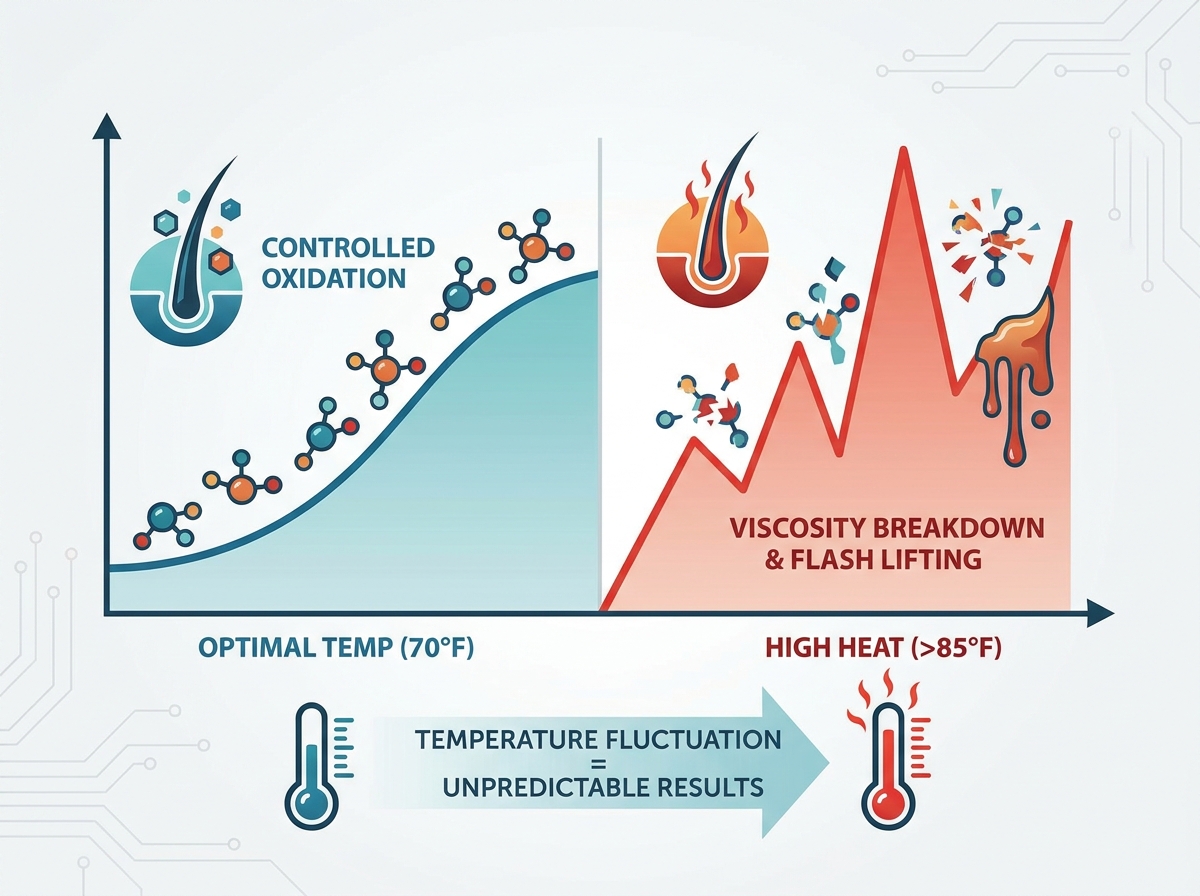
Temperature dictates the speed of chemical oxidation during hair color processing; a 10°F shift can fundamentally alter lifting and depositing rates.
Unstable color formulations experience viscosity breakdown (runniness) under heat, leading to foil slippage, overlapping, and banding.
Evaluating a professional permanent hair color cream requires specific criteria: thermal viscosity retention, controlled alkalizing release, and a predictable oxidation curve.
Standardizing mixing room and ambient salon temperatures is a baseline requirement for reducing expensive corrective color services.
Chemical reactions thrive on thermal energy. When you mix a color tube and developer, you initiate a delicate chemical dance. Heat acts as a powerful catalyst in this scenario. It excites molecules and accelerates their movement. This thermal energy opens the cuticle layer rapidly. It also speeds up the oxidation of dye precursors inside the hair cortex.
Understanding activation energy is crucial for any master colorist. Every formula requires a specific energy threshold to begin oxidizing. Room temperature usually provides enough baseline energy. Applying external heat pushes the reaction into overdrive. This acceleration fundamentally alters hair color processing. The dye precursors couple prematurely before they penetrate deeply. This leads to superficial color deposits and rapid fading.
We must also examine the oxidation curve. A high-quality formula relies on a linear processing curve. It lifts natural melanin and deposits synthetic pigment at a steady, controlled pace. Predictability allows you to formulate accurately. Conversely, unstable formulas suffer from erratic processing under heat. They experience flash lifting. The hair lightens too quickly and exposes raw, unwanted underlying pigments. Dye molecules then couple unevenly, creating patchy results.
Reaction Type | Temperature Trigger | Lifting Pace | Deposit Result |
|---|---|---|---|
Linear Processing | Stable Room Temp (70°F) | Gradual and controlled | Deep penetration, long-lasting |
Erratic Processing | Heat Spike (85°F+) | Flash lifting, rapid melanin destruction | Superficial coupling, quick fading |
Stalled Processing | Cold Drafts (Below 65°F) | Sluggish, incomplete lift | Translucent, poor gray coverage |
Alkalizing agents also react differently to temperature changes. Ammonia is highly volatile. It evaporates rapidly when exposed to warm ambient air. This sudden evaporation often causes the pH of the mixture to drop. The cuticle may close prematurely, stalling the color process. Monoethanolamine (MEA) behaves differently. It does not evaporate easily. MEA remains active on the scalp even under heat. This sustained alkalinity can cause severe scalp irritation. It severely compromises hair integrity if left unchecked.
Best Practice: Always monitor the ambient temperature in your mixing room to ensure predictable oxidation.
Common Mistake: Placing a mixing bowl near a sunny window, causing volatile ammonia to flash off prematurely.
Best Practice: Use barrier creams when working with MEA-based colors under warm conditions to protect the client's scalp.
Your salon environment is rarely uniform. Microclimates exist throughout the space and directly on the client's head. Recognizing these specific variables is essential for formulation accuracy.
Consider the natural zone variations on a client's head. The scalp area, known as Zone 1, radiates continuous body heat. This area usually rests around 98°F. Meanwhile, the mid-lengths and ends sit closer to ambient room temperature, typically around 70°F. This creates a massive 10°F to 15°F temperature gap. High-performance formulas must bridge this gap seamlessly. If they fail, you experience "hot roots." The hair nearest the scalp lifts much faster and warmer than the ends. Stylists must adjust developer volumes to counteract this natural thermal imbalance.
Ambient environmental shifts play a massive role too. HVAC drafts blow cold air directly onto processing clients. This stalls chemical reactions entirely. Seasonal changes force you to constantly adapt. Winter brings cold, dry air. Summer introduces high heat and humidity. Furthermore, hot tools operate constantly near the processing area. A stylist blow-drying hair three feet away raises the localized temperature significantly. These subtle shifts alter processing times daily.
External heat application remains the most dangerous variable. Hooded dryers and climatic processors apply intense, concentrated heat. They push chemical reactions to their absolute limits. Foils act as thermal insulators. They trap natural oxidative heat inside a small, enclosed space. As the chemical reaction generates its own thermal energy (an exothermic reaction), the foil prevents it from escaping. This compounding heat dramatically accelerates lifting speed. It can easily push hair past its structural breaking point.
When formulations fail under heat stress, your salon suffers financially. Structural instability causes immediate application nightmares. Viscosity breakdown represents the most common failure. Hair color relies on a delicate emulsion base to maintain its creamy texture. Heat destroys these emulsion stabilizers. The product liquefies rapidly in the bowl or inside the foil.
When structural integrity fails, the color runs. It bleeds out of foils and creates harsh banding. Runny lightener overlaps onto previously lightened hair. This overlap creates a severe breakage risk. You must trust your professional permanent hair color cream to stay exactly where you place it. If it melts under body heat, precision techniques like balayage become impossible.
The cost of inconsistency drains salon profitability. Temperature anomalies lead to under-processed or over-processed results. These errors require immediate corrective redos. Redos are not just minor inconveniences. They represent a massive financial drain.
Product Waste: Calculate the exact cost of the extra color tubes, developer, and treatments used during the correction.
Lost Time: Multiply the stylist's hourly rate by the hours spent fixing the mistake.
Opportunity Cost: Factor in the revenue lost from turning away new clients during that blocked-out time.
Material Overhead: Add the cost of extra foils, gloves, water, and electricity.
Client retention risks pose an even greater threat. Modern clients demand perfection. Compromised structural integrity damages hair permanently. Inconsistent gray coverage frustrates clients who pay premium prices. Temperature-driven formulation failures damage your reputation. A client who leaves with banded, damaged hair rarely returns. They also share their negative experiences online. Protecting your brand requires eliminating these unpredictable variables entirely.
Choosing a reliable color line requires rigorous testing. You cannot rely solely on beautiful swatch books. You must evaluate the chemical stability of the product under real-world conditions. Establish strict criteria before bringing a new line into your dispensary.
Thermal viscosity retention is your first testing metric. You must verify if a brand's emulsion base maintains stability. Conduct a simple stress test. Mix two identical bowls of color. Leave one at a standard 70°F. Place the other in a warm 85°F environment. Check them after thirty minutes. A high-quality formula remains thick and creamy in both bowls. An unstable formula separates, becomes watery, or swells excessively.
Controlled pigment coupling is equally important. Assess the manufacturer's data regarding dye intermediate stability. The pigment must develop accurately regardless of minor ambient fluctuations. Some formulas shift off-tone when exposed to slight heat. Ash tones may pull green. Warm tones may become overly brassy. You need a formula that locks in true-to-tone results consistently.
Does the emulsion maintain a thick consistency after 45 minutes at 80°F?
Does the manufacturer provide clear, written guidelines on external heat usage?
Do ash and cool tones remain stable without shifting muddy under warm conditions?
Is the mixing ratio forgiving enough for minor environmental shifts?
Manufacturer transparency reveals a brand's true quality. Evaluate the clarity of their technical manuals. Do they explicitly forbid external heat? Do they provide adjusted processing times for different climates? Brands that hide this information usually have unstable formulas. You need clear, optimal mixing environment guidelines to succeed.
Finally, consider the scalability of use. Can junior stylists achieve the same results as senior colorists? A highly volatile product requires constant micro-management. Senior colorists might know how to tweak the formula to compensate for a hot room. Junior stylists will likely fail. You need a product robust enough to perform consistently across your entire staff.
Standardizing your salon environment eliminates thermal unpredictability. You must implement strict operational protocols. This begins in the backroom and extends to every styling station.
Mixing room climate control is non-negotiable. You must store liquid developers and color tubes in temperature-controlled environments. Storing developer in a hot storage closet degrades the hydrogen peroxide. It loses its lifting power before you even open the bottle. Color tubes exposed to extreme heat suffer from premature oxidation. Keep your dispensary at a stable 68°F to 72°F year-round. Install a dedicated thermostat in the mixing room if necessary.
Phasing out unpredictable lines requires a strategic operational rollout. Never test a new color line on paying clients immediately. Test the products on mannequins first. Expose these mannequins to various salon temperature conditions. Process one near a drafty window. Process another under a hooded dryer (if permitted by the manufacturer). Observe how the viscosity and tone hold up. Only adopt the line salon-wide after it passes these rigorous thermal stress tests.
Establishing Standard Operating Procedures (SOPs) protects your business. Create strict salon rules regarding applied heat. Base these rules entirely on verified manufacturer guidelines. For example, you might establish an SOP that permits heat only for specific resistant gray protocols. You might ban heat entirely for all lightening techniques. Print these SOPs and post them in the dispensary. Train every staff member to follow them without exception. Consistency in protocol breeds consistency in results.
Weekly Redos | Estimated Product Waste (Monthly) | Lost Revenue Potential (Monthly) | Client Attrition Risk |
|---|---|---|---|
1 - 2 | $100 - $200 | $600 - $1,200 | Low to Moderate |
3 - 5 | $300 - $500 | $1,800 - $3,000 | High |
6+ | $600+ | $3,600+ | Severe brand damage |
Managing salon temperature transcends basic technical skill. It serves as a crucial operational baseline for long-term profitability. You cannot achieve consistent, high-end results if your chemical environment constantly fluctuates. Taking control of your ambient climate protects your inventory, your schedule, and your reputation.
Choosing a high-quality color line requires looking past beautiful packaging and glossy swatch books. You must analyze the chemical stability of the product under real-world, fluctuating conditions. True performance is measured by how well a formula resists viscosity breakdown and erratic oxidation when the salon environment shifts.
Actionable Next Steps:
Place a digital thermometer in your dispensary today to track daily temperature fluctuations.
Conduct a 70°F versus 85°F thermal stress test on your primary color line this week.
Consult with your manufacturer educator to audit and update your processing protocols.
Draft a formal SOP regarding external heat usage and require all stylists to review it.
A: Yes. Higher ambient temperatures accelerate oxidation and cuticle swelling, potentially leading to over-processing. Conversely, cold environments can stall the chemical reaction. This results in poor color deposit, weak gray coverage, or inadequate lifting.
A: No. Application of external heat should strictly follow manufacturer instructions. Many modern formulas are calibrated specifically for room temperature. Adding heat can cause rapid viscosity breakdown, unpredictable chemical acceleration, and severe hair damage.
A: This typically indicates a breakdown of the emulsion stabilizers. It is often triggered by mixing the product in a hot environment or exposing it to direct heat. This destroys the product's viscosity and leads to severe application issues like foil bleeding and banding.


