
Views: 0 Author: Site Editor Publish Time: 2026-10-16 Origin: Site

Launching a new hair care line presents immense commercial opportunities. However, chemically treated hair demands scientific precision. Consumers will quickly abandon your brand if their vibrant salon shades fade after just a few washes. This poses a significant commercial risk for beauty businesses everywhere. Products designed for color retention must demonstrate verifiable efficacy. You need proven results to secure repeat purchases and build long-term brand loyalty.
A specialized OEM partner bridges a critical gap in product development. They transform early clinical formulation concepts into scalable, compliant manufacturing processes. You must establish a baseline requirement early on. A true post-color hair care regimen requires integrated chemistry across multiple product stages. Isolated, generic formulations simply cannot deliver the necessary cuticle protection.
In this article, you will learn how top manufacturers design systematic product architectures. We will explore formulation parameters, scaling protocols, and strict quality assurance frameworks. These insights will help you evaluate and choose the right manufacturing partner.
Successful post-color lines require a unified approach to pH balance and surfactant selection across both wash and conditioning stages.
Evaluating an OEM depends on their ability to transition formulations from bench-scale pilot tests to high-shear, large-batch manufacturing.
Reliable manufacturing partners prioritize stability testing, ensuring active ingredients like UV filters and antioxidants do not degrade at scale.
Shortlisting criteria should focus on facility certifications (ISO/GMP), formulation transparency, and rigorous quality assurance protocols.
Dye molecules easily escape through an open hair cuticle. OEMs design products to work sequentially to minimize this dye molecule leaching. A unified system approach controls the hair's environment from start to finish. First, the cleansing phase prepares the canvas. Next, the conditioning phase seals the structure. They must function as a complementary pair.
Creating a reliable color lock shampoo requires strict chemical engineering. Formulas must utilize sulfate-free, low-pH wash systems. These cleansers remove sebum and buildup effectively. Crucially, they cleanse without aggressively stripping the cuticle. Harsh sulfates swell the hair shaft prematurely. This swelling forces artificial pigments out during the rinse cycle. Premium shampoos rely on gentle alternatives like sodium cocoyl isethionate.
After cleansing, the hair requires deep structural reinforcement. OEMs carefully formulate a dedicated color save hair treatment to follow the wash. They integrate specific conditioning agents and cationic polymers. These positively charged molecules bind to damaged, negatively charged hair strands. Formulators also include sealants to close the cuticle tightly. This process locks in essential hydration and pigment post-wash.
Every product in a kit must interact safely. Manufacturers ensure cross-product compatibility during the R&D phase. Viscosity, fragrance profiles, and active ingredients must remain stable. They also need to be complementary across the entire product suite. If a shampoo leaves a specific residue, the conditioner must neutralize it. Chemical clashes lead to product separation or poor consumer experiences.
Surfactants form the backbone of any cleansing product. Evaluating non-ionic and amphoteric surfactants is essential for color preservation. Ingredients like decyl glucoside provide adequate foaming. More importantly, they cause minimal cuticle disruption. Formulators balance the ratio of these gentle cleaners. You achieve rich lathers without compromising dye longevity.
Raw materials degrade when exposed to air and light. Manufacturers must source and stabilize sensitive compounds carefully. Formulators rely on specific antioxidant profiles, amino acid blends, and UV filters. These components prevent environmental color degradation. Oxidative stress from sunlight quickly turns vibrant blondes brassy. Encapsulated UV filters protect the strand without feeling heavy.
Hair thrives in a slightly acidic environment. The technical necessity of maintaining acidic to neutral pH levels is absolute. Manufacturing processes typically target a pH range of 4.5–5.5. This acidity keeps the cuticle scales lying flat. Flattened scales reflect light better and trap color molecules inside. Formulators monitor pH continuously during mixing.
You must trust the origin of your raw materials. Assessing the OEM’s ability to provide detailed documentation is a priority. Brands need proof of raw material purity and ethical sourcing. Regulatory compliance heavily depends on transparent supply chains.
Consider these key supply chain verification steps:
Request Certificates of Analysis (COA) for all active ingredients.
Verify ethical sourcing claims for natural oils and botanical extracts.
Review Safety Data Sheets (SDS) for synthetic polymers and preservatives.
Audit supplier compliance records against global cosmetic regulations.
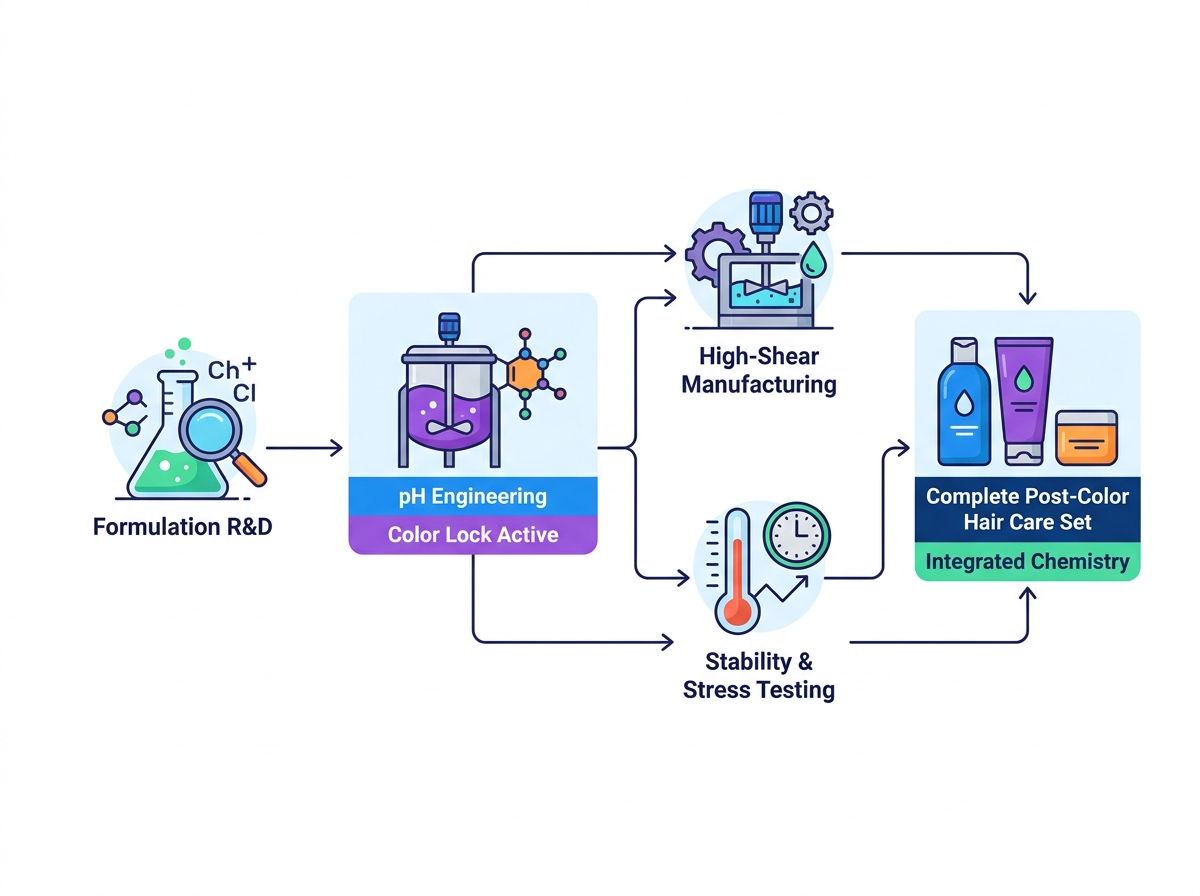
Moving from a laboratory beaker to an industrial vat presents immense challenges. Developing standard operating procedures (SOPs) is the first scaling step. Engineers plan precise mixing sequences and establish temperature thresholds. They conduct pilot batching before mass production begins. This small-scale run reveals potential stability issues. It ensures the formula behaves predictably during scale-up.
Conditioning treatments require complex emulsions. Industrial machinery properly blends oil-soluble actives into water-based treatments. High-shear mixing prevents these components from separating over time. The equipment breaks oil droplets down to microscopic sizes. This creates a smooth, luxurious texture. Proper emulsification ensures even distribution of color-protecting actives.
Temperature fluctuations destroy delicate ingredients. Managing heating and cooling phases requires strict oversight. You must prevent the degradation of heat-sensitive botanical extracts. Synthetic color-protecting actives also lose efficacy if overheated. Cooling jackets surround the mixing vats to lower temperatures rapidly. Controlled cooling preserves the chemical integrity of the final product.
Exposure to oxygen degrades cosmetic formulas quickly. Ensuring precise dosing into commercial packaging is a technical necessity. Automated assembly lines minimize oxidation and contamination risks. Machinery often flushes bottles using nitrogen gas before filling. This displaces oxygen and extends product shelf life. Capped products then move to final inspection and labeling.
Formulas must survive extreme real-world conditions. Facilities run rigorous protocols for subjecting formulations to extreme environments. They test reactions to elevated temperature, intense light, and high humidity. This verifies long-term efficacy and shelf life. Accelerated aging tests simulate years of degradation in just weeks. If a formula separates at 45°C, formulators must adjust the emulsifiers.
Table 1: Standard OEM Quality Control Testing Parameters
Test Category | Methodology | Primary Purpose |
|---|---|---|
Accelerated Stability | Incubation at 45°C for 12 weeks | Predicts long-term shelf life and emulsion integrity. |
Freeze-Thaw Cycling | Alternating between -10°C and 25°C | Ensures products survive harsh shipping climates. |
Microbial Challenge | Inoculation with standard pathogens | Verifies preservative system efficacy over time. |
Viscosity Checking | Spindle viscometer measurement | Guarantees consistent texture and pump functionality. |
Water-based products easily breed dangerous pathogens. Implementing strict testing phases prevents bacterial or fungal growth. Quality control teams test samples before, during, and after filling. They perform preservative efficacy testing (PET) to challenge the formula. A robust preservative system neutralizes introduced microbes rapidly. This guarantees consumer safety upon final delivery.
Selling cosmetics internationally requires heavy paperwork. Navigating FDA, EU, and global cosmetic regulations requires dedicated compliance experts. Reputable OEMs handle safety data sheet (SDS) generation. They also ensure accurate ingredient labeling. Mislabeling chemical compounds leads to costly product recalls. Partners must stay updated on ever-changing global ingredient bans.
Consumers expect the exact same product every time they purchase. OEMs use lot tracking and retain samples for quality assurance. They ensure every production run matches the approved master formula exactly. If a customer reports an issue, traceability resolves it quickly. Facilities can pull the retained sample from that specific batch. This allows them to investigate deviations accurately.
Do not assume all factories possess identical capabilities. You must ask key questions regarding their equipment limits. Inquire about their maximum batch sizing and reverse-engineering capabilities. Some facilities specialize only in simple liquids. Others handle thick, complex conditioning creams. Ask if they can reverse-engineer benchmark products you admire. This proves their chemical expertise.
Verbal promises do not guarantee factory safety. The commercial necessity of partnering with certified facilities is non-negotiable. Look for ISO 22716 and cGMP-certified partners immediately. These globally recognized standards dictate strict hygiene and operational rules. Regular third-party audits maintain these certifications. Facilities lacking these documents present massive liability risks.
Your launch volumes will differ from your mature volumes. Aligning your brand’s initial launch requirements with the manufacturer’s Minimum Order Quantities (MOQ) is vital. Evaluate their long-term scaling capacity as well. A factory requiring 50,000 units upfront crushes startup cash flow. Conversely, a boutique lab might struggle to produce 100,000 units later. Find a flexible middle ground.
Delays ruin marketing schedules and launch plans. Setting realistic expectations for formulation approval is crucial. Understand timelines for raw material procurement and final delivery schedules. Ask potential partners about their average turnaround times.
R&D phase typically requires 4 to 8 weeks.
Stability testing demands an uncompromised 8 to 12 weeks.
Packaging procurement often takes 6 to 10 weeks simultaneously.
Final production and filling usually complete in 3 to 4 weeks.
Building a verifiable, high-performance product line requires an OEM with proven expertise. They must master precise pH manipulation and stable emulsification techniques. Do not treat formulation as a simple mixing exercise.
Evaluating a manufacturer goes far beyond negotiating the cost per unit. It requires thoroughly assessing their quality control frameworks and compliance rigor. Cheap production costs mean nothing if formulas separate on retail shelves. A bad batch damages consumer trust permanently.
Take action by evaluating your current or prospective manufacturing partners carefully. Prompt your decision-makers to initiate initial consultations today. Request stability testing data and facility certification documents from potential partners. Prioritize transparency and chemical expertise to ensure your launch succeeds.
A: Timelines generally range from 12 to 24 weeks, accounting for R&D, stability testing (typically 8-12 weeks), packaging procurement, and final manufacturing.
A: Yes, reputable OEMs offer base formulations that can be modified with specific botanical extracts, signature fragrances, or targeted active ingredients to meet brand positioning requirements.
A: Manufacturers utilize wash-out tests on dyed hair swatches, spectrophotometer readings to measure color fading, and tensile strength testing to validate conditioning claims.
A: Minimum Order Quantities vary by facility but typically range from 5,000 to 10,000 units per SKU for fully custom formulations, with lower thresholds often available for standard private label bases.


